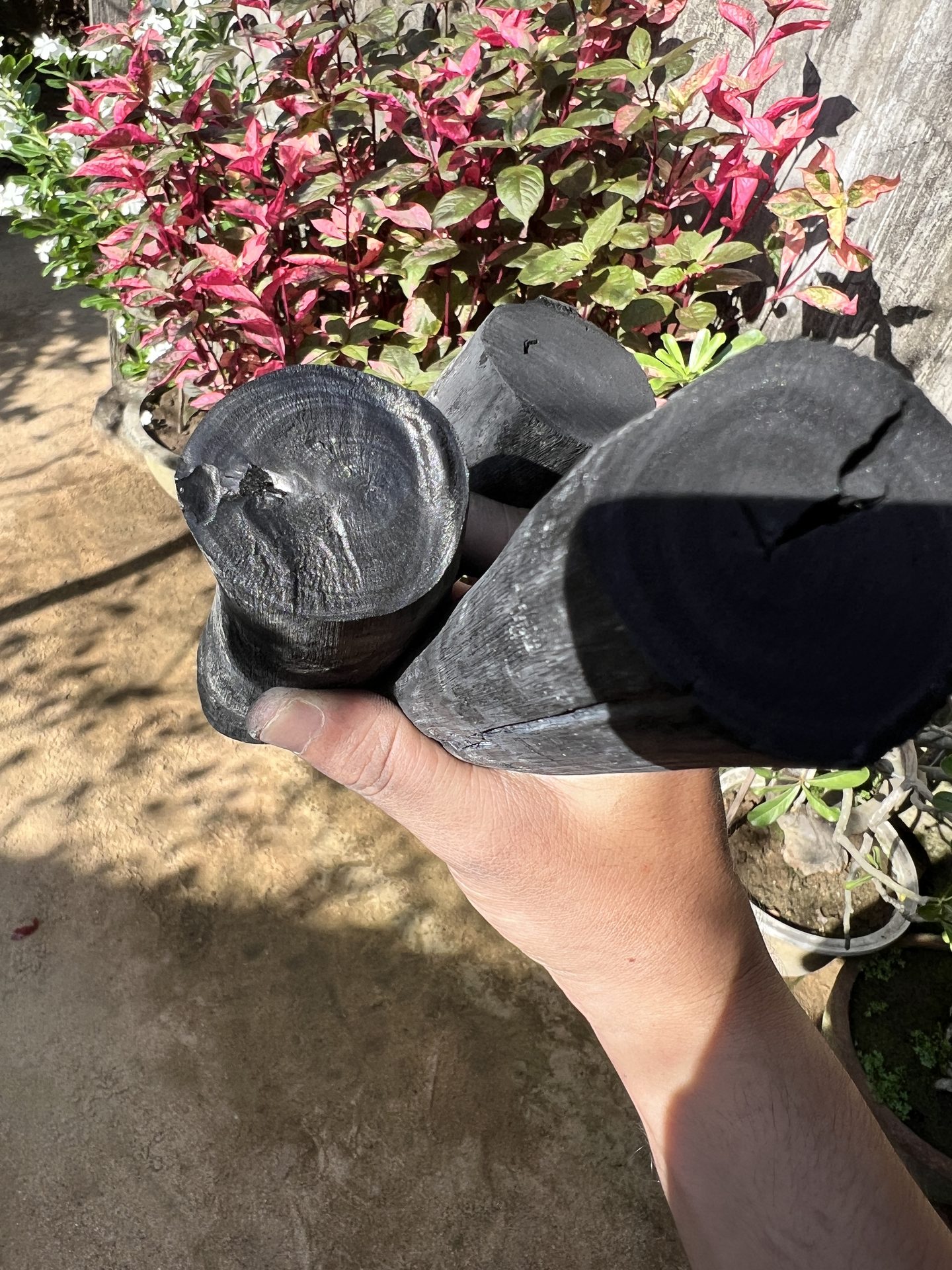
What Is Japanese Binchotan?
Traditional Japanese binchotan is a white charcoal made from ubame oak, most closely associated with the Kishu region of Wakayama Prefecture. Producers use a high-temperature carbonization method finished with a white ash coating (a process often called “shirozumi”), which is prized by chefs for long, stable heat and minimal smoke. Because ubame oak grows slowly and traditional kiln capacity is limited, genuine Japanese binchotan is generally positioned as a premium, limited-supply product, and it can be difficult for importers to source in consistent export volumes.
What Is Vietnamese Eucalyptus Binchotan-Style Charcoal?
SOHI Binchotan-style white charcoal is produced in Vietnam from Vietnamese white eucalyptus wood, not oak. It is carbonized at high temperature and kiln-cured to develop a dense carbon structure and increased hardness — buyers who strike two pieces together report the same dense, metallic ringing sound associated with binchotan-quality charcoal. We use the term “Binchotan-style” to describe this similar hardness and burning performance, always paired with “Vietnamese” and/or “Eucalyptus”: it is not Japanese-origin binchotan, and SOHI does not represent it as made in Japan or Japanese-certified.
Key Differences at a Glance
| Factor | Traditional Japanese Binchotan | SOHI Vietnamese Eucalyptus Binchotan-Style |
|---|---|---|
| Raw material | Ubame oak | Vietnamese white eucalyptus wood |
| Origin | Japan (Kishu / Wakayama region) | Vietnam |
| Positioning | Premium, limited-supply, artisanal | Cost-effective alternative for commercial and export buyers |
| Export volume availability | Often limited | Container-scale export supply, FOB/CIF quotation support |
| Reported ring sound | Dense, metallic ring (widely reported by users) | Buyers report a comparable dense, metallic ring |
General information about traditional Japanese binchotan is provided for buyer context only and does not describe SOHI's own product.
SOHI Tested Sample Reference Values
| Parameter | Tested sample result |
|---|---|
| Fixed carbon | 90–95% |
| Moisture | <3% |
| Ash | <3% |
| Heating value | 7,500–8,000 Kcal/kg |
| Volatile matter | 2.35% |
| Total sulfur | 0.015% |
These are test-reference values for the tested sample; results can vary by batch. Test-report references are available for buyer review.
Why Buyers Choose Vietnamese Eucalyptus Binchotan-Style Charcoal
Stable heat for precise grilling: Designed for consistent, stable heat output suited to BBQ restaurants and grilled-food applications.
No Smoke, No Odor: Once fully lit, it burns clean — no smoke, no odor — suitable for restaurant and indoor barbecue use.
Low-ash performance: Tested-sample ash content of <3% supports cleaner handling for BBQ applications.
Renewable raw material: Made from Vietnamese white eucalyptus wood.
Export-ready packing: 10 kg and 15 kg cartons as standard; other packing can be discussed.
Commercial trade terms: FOB and CIF quotation support, with samples that can be discussed before commercial ordering.
Buyer FAQ
Is SOHI charcoal made in Japan?
No. SOHI Binchotan-style white charcoal is produced in Vietnam from Vietnamese white eucalyptus wood, not the oak used in Japanese binchotan. “Binchotan-style” describes similar hardness and burning characteristics, not Japanese origin or certification.
Has this product actually been exported to Japan?
Yes. A customs-inspected test report references an actual shipment of this eucalyptus white charcoal from Cat Lai, Vietnam to Osaka, Japan. This is separate from, and does not imply, Japanese origin or certification of the product itself.
What is the minimum order quantity?
Standard commercial MOQ is approximately 10–11 MT for a 20 ft container, subject to packing and loading plan. FOB and CIF quotation support is available.
Can I request a sample before ordering?
Yes, samples can be discussed before commercial ordering. Test-report references are also available for buyer review.
What packing options are available?
Standard packing is 10 kg or 15 kg per carton. Other packing arrangements are subject to discussion.
Why does the charcoal make a metallic ringing sound?
Buyers who strike two pieces together often report a dense, metallic ringing sound consistent with binchotan-quality charcoal. This is a buyer-reported characteristic rather than an engineered guarantee, and it reflects the dense carbon structure produced during high-temperature carbonization and kiln-curing.